From red stripes and coal diamonds to European contractor colours. Select a scheme to change the locomotive and discover its story.
British Rail
Railfreight Red Stripe
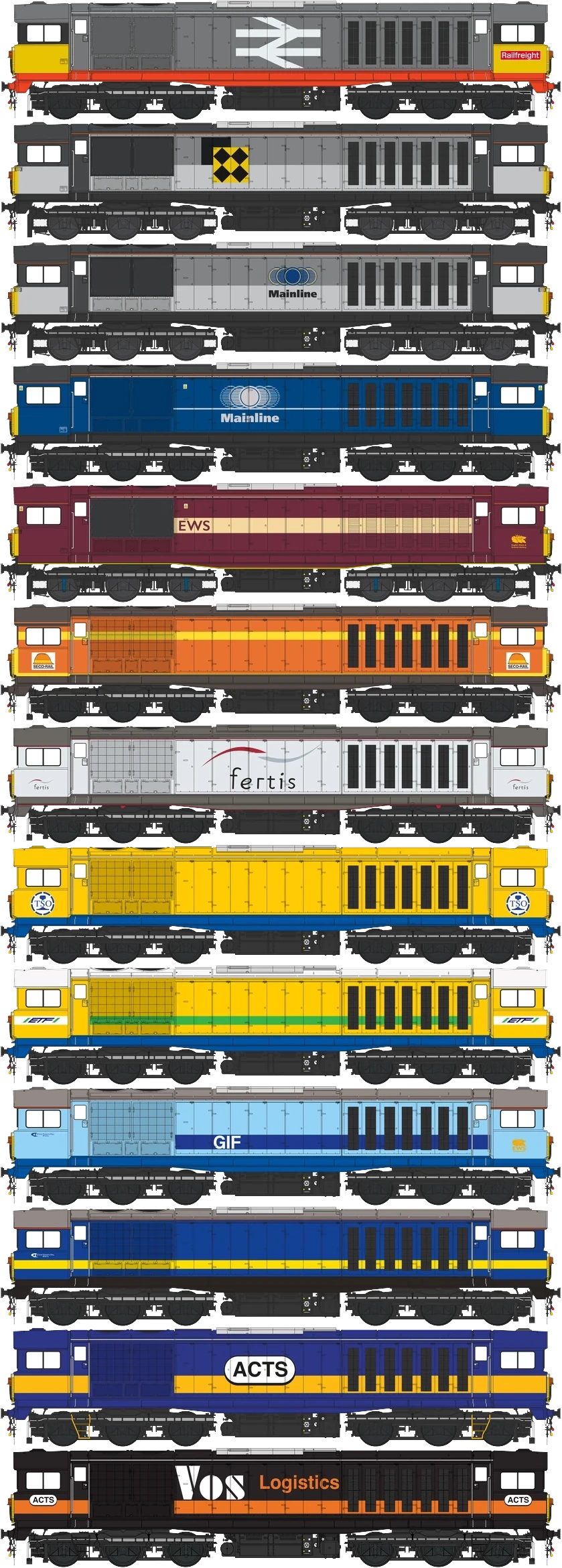
The original identity worn by all 50 locomotives on leaving Doncaster: grey bodywork, yellow cab ends, a red solebar and the large white British Rail double-arrow.
The Group’s own palette takes inspiration from this distinctive freight identity.
Explore This Chapter →British Rail
Trainload Coal
Triple-grey bodywork and the black-and-yellow Coal sector emblem reflect the class’s close association with coal traffic.
British Rail introduced its Railfreight sub-sector identities in 1987.
Explore This Chapter →Mainline Freight
Mainline Triple Grey
The triple-grey base remained, now carrying Mainline’s blue-and-yellow rolling-wheels identity on the engine-room doors.
This was one of the transitional appearances between British Rail sectorisation and full Mainline blue.
Explore This Chapter →Mainline Freight
Mainline Blue and Silver
Blue bodywork, a silver stripe and silver Mainline branding created a very different look for the class during the privatisation era.
Individual locomotives also carried transitional and component-change variations.
Explore This Chapter →EWS
EWS Maroon and Gold
Maroon and gold marked the EWS era. The class carried different lettering and emblem arrangements, including the Three Beasties logo.
This illustration represents one principal scheme; it is not a record of every individual variation.
Explore This Chapter →France
Seco Rail
Orange, black and yellow gave locomotives working on French infrastructure projects a distinctive contractor identity.
The Group’s livery history records black roofs, orange bodies and cabs, a yellow band and yellow front ends.
Explore This Chapter →France
Fertis
Very light-grey bodywork and large Fertis lettering replaced the darker British freight schemes on these French-worked locomotives.
The livery history also records grey roofs and underframes, black bogies and purple numbering.
Explore This Chapter →France
Tso
A white roof, yellow body and light-blue underframe made the TSO scheme particularly easy to recognise.
The Group’s history lists 58033, 58047, 58049 and 58050 as having carried this livery.
Explore This Chapter →France
Etf
The existing artwork records a yellow-and-green ETF identity, with a white roof and blue underframe, from the French infrastructure chapter.
Use the French history and photo archive to explore individual locomotives and changes in detail.
Explore This Chapter →Spain
Gif
Powder-blue bodywork, yellow cab ends and a dark-blue band carrying GIF lettering are associated with the class’s Spanish infrastructure work.
Grilles, window surrounds and lettering varied between individual locomotives.
Explore This Chapter →Spain
Continental Rail
The artwork shows a darker-blue Continental Rail appearance, with a yellow bodyside stripe and yellow warning panels.
This is a visual selection from the existing artwork, not a dated fleet-by-fleet livery record.
Explore This Chapter →Netherlands
ACTS
Blue bodywork, a yellow-orange band and large ACTS logos marked the locomotives’ Dutch export chapter.
Export locomotives also received visible front-end alterations to lights and other fittings.
Explore This Chapter →Netherlands
ACTS / Vos Logistics
Black bodywork and a strong orange stripe created the striking Vos Logistics variation of the Dutch ACTS identity.
The large bodyside ACTS logos were replaced by smaller cab-side logos.
Explore This Chapter →