Class 58 Quiz
History • Preservation • Community
How Well Do You Know the Class 58?
Explore the fleet’s history, engineering and liveries. Choose a standalone 10- or 20-question quiz, or take on the separate 30-question discount challenge.
10 or 20 Question Class 58 Quiz
Choose 10 or 20 questions about Class 58 history, engineering and liveries. Get your score and download a branded result certificate when you finish. Play as often as you like; no account or email is required.
Ready for the Quiz?
Explore 100 questions about Class 58s. Each round is shuffled, with no repeated question within the round. There is no timer or leaderboard; your score stays on your device.
Which British Number Became ACTS Locomotive 5811?
ACTS 5811 was formerly 58039.
Explore the Reference →In Which Country Did ACTS Operate Class 58s?
ACTS used Class 58s in the Netherlands.
Explore the Reference →Whose Blue-and-Silver Identity Is Shown?
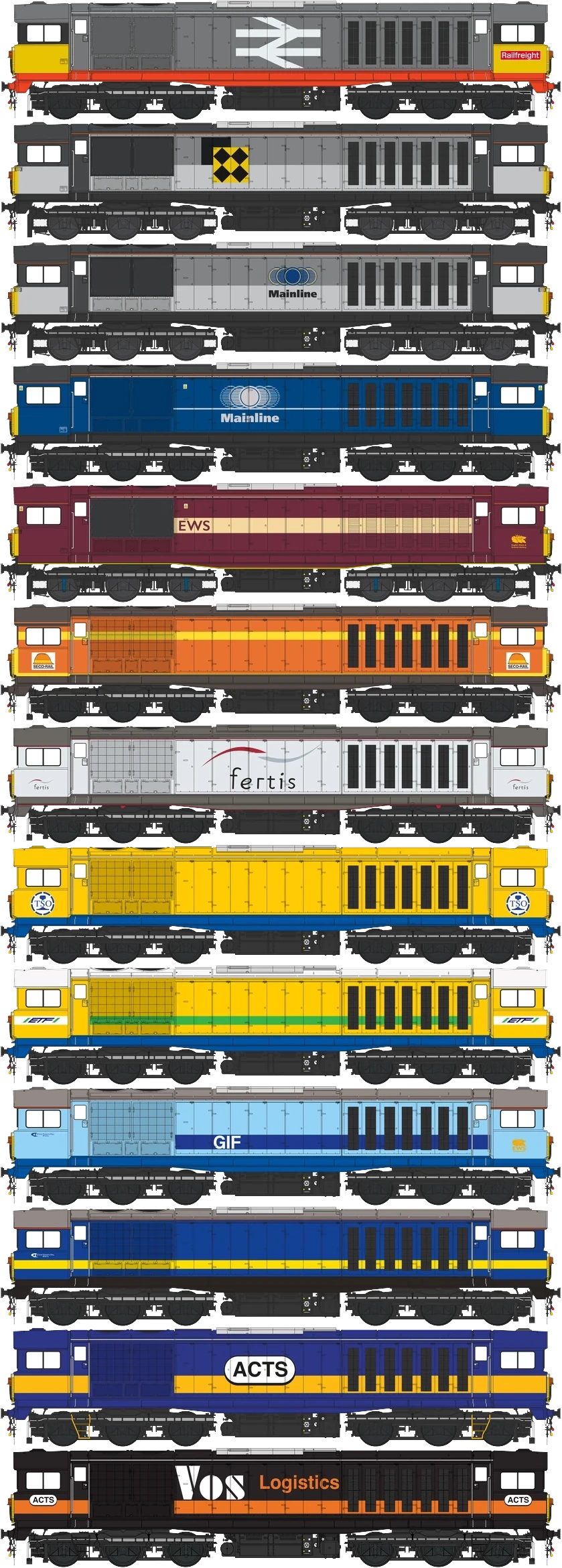
Blue bodywork, silver lining and the rolling-wheels identity belong to the Mainline Freight scheme.
Explore the Reference →What Is the Class 58 Wheel Arrangement?
Two three-axle bogies give the Class 58 a Co-Co wheel arrangement.
Explore the Reference →Which Train Brake Type Is Listed for the Class 58?
Air is the specified brake type.
Explore the Reference →Where Were the Class 58s Built?
The fleet was built by BREL at Doncaster.
Explore the Reference →At Which End Is the No. 1 Driving Cab?
The No. 1 cab is at the Cooler Group end; the No. 2 cab is at the Electrical Cubicle end.
Explore the Reference →Which Class 58 Launched the Coal Sector Livery?
58050 was the Coal launch locomotive.
Explore the Reference →In Which Year Were the Railfreight Sub-Sectors Officially Launched?
The freight sub-sectors launched in 1987.
Explore the Reference →Which Sector Identity Is Illustrated?
The black-and-yellow Coal emblem accompanies the triple-grey scheme shown here.
Explore the Reference →In Which Year Did Work on the Class 58 Design Begin?
The design story began in 1979.
Explore the Reference →Why Are There Access Doors Along the Bodyside?
The Class 58 has no internal corridor. The bodyside doors provide direct access to its equipment areas.
Explore the Reference →Which Engine Type Powers a Class 58?
The engine is the Ruston Paxman 12RK3ACT.
Explore the Reference →Which Colours Are Associated with the EWS Livery?
Maroon and gold formed the EWS corporate scheme.
Explore the Reference →Which Class 58 First Appeared in EWS Colours?
58033 carried the early EWS scheme with its unusually high gold band.
Explore the Reference →What Did EWS Stand For?
EWS represented English, Welsh & Scottish Railway.
Explore the Reference →How Many Class 58 Locomotives Were Built?
Fifty locomotives were built, numbered 58001 to 58050.
Explore the Reference →Which French High-Speed Line PROJECT Employed Class 58s?
Class 58s supplied engineering traction for LGV Est.
Explore the Reference →Which Country Is Associated with This Gif Scheme?
This powder-blue GIF appearance is associated with Spanish infrastructure work.
Explore the Reference →Which Depot Initially Received the Entire Class 58 Fleet?
The original fleet allocation was to Toton.
Explore the Reference →When Was the Final Class 58 Accepted into Traffic?
The final locomotive was accepted in March 1987.
Explore the Reference →Which Traffic Became Especially Associated with the Class 58?
Merry-Go-Round coal workings defined much of their British Rail service.
Explore the Reference →What Was a Key Aim of the Modular Class 58 Design?
Modular construction aimed to simplify building and maintaining the locomotives.
Explore the Reference →How Many Traction Motors Does a Class 58 Have?
There is an individual traction motor for each of the six powered axles.
Explore the Reference →Which Multiple-Working Symbol Applies to Class 58s?
Class 58 multiple working uses Red Diamond.
Explore the Reference →Which Nickname Is Associated with the Class 58?
Bones is one of the class’s familiar nicknames.
Explore the Reference →What Engine Output Is Recorded in the Group’s Specification?
The Ruston Paxman 12RK3ACT engine is rated at 3,300 horsepower.
Explore the Reference →Which Livery Is Shown?
Grey bodywork, yellow cab ends and a red solebar identify the original Railfreight Red Stripe scheme.
Explore the Reference →In Which Year Did the First Class 58 Enter Service?
The Group’s history records the first entry into service in 1983. This is distinct from the start of design and construction work.
Explore the Reference →In Which Year Did the First Class 58s Arrive in Spain?
The first Spanish arrivals were in 2003.
Explore the Reference →Which Pair Began the Class 58’s Spanish Chapter?
58041 and 58043 formed the first pair sent to Spain.
Explore the Reference →What Work Took Class 58s to Spain?
They worked on AVE high-speed railway infrastructure projects.
Explore the Reference →Which 1984 Event Disrupted the Class’s Coal Duties?
The miners’ strike interrupted coal traffic in 1984.
Explore the Reference →What Is the Class 58 Maximum Speed?
The published maximum is 80 mph.
Explore the Reference →What Weight Is Listed for a Class 58?
The specification lists 130 tonnes.
Explore the Reference →Why Did the Original Railfreight Scheme Use Yellow Cab Ends?
Yellow cab ends helped visibility, including in dusty coal environments.
Explore the Reference →What Was the Name of the Class 58 Farewell Passenger Railtour in August 2002?
Hertfordshire Railtours’ Bone Idol was hauled by 58020 and 58024.
Explore the Reference →Which Markets Did the Original Class 58 Design Aim to Serve?
The design aimed to suit British duties while also offering export potential.
Explore the Reference →When Did the Class 58 Passenger Story Begin with a Railtour?
The first passenger railtour took place on 18 September 1983.
Explore the Reference →What Fuel Capacity Is Listed for a Class 58?
The specification gives a 4,480-litre fuel capacity.
Explore the Reference →On Which Date Did the Bone Idol Farewell Railtour Run?
The tour ran on 26 August 2002, the August Bank Holiday Monday.
Explore the Reference →Which Structure Supports the Class 58’s Non-Load-Bearing Bodyside Panels?
A substantial girder-frame chassis supports the locomotive; its bodyside panels are non-load-bearing.
Explore the Reference →Which Main Alternator Type Is Listed?
Brush BA1101B is the main alternator type.
Explore the Reference →Which Interim Freight Business Became Mainline Freight?
Trainload Freight South East was renamed Mainline Freight.
Explore the Reference →Approximately How Long Is a Class 58?
The published overall length is 19.13 metres.
Explore the Reference →Which Route Availability Number Is Listed for the Class 58?
The Class 58 is listed as Route Availability 7.
Explore the Reference →What Type of Sanding Equipment Is Listed?
The sanding equipment is electro-pneumatic.
Explore the Reference →Which Three Names Followed the 1994 Regional Split of Trainload Freight?
The regional businesses became Mainline Freight, Transrail and Loadhaul.
Explore the Reference →Which Traction Motor Type Is Listed?
The specified traction motor is the Brush TM73-62.
Explore the Reference →What Train Heating Equipment Is Listed?
No train heating equipment is listed for the class.
Explore the Reference →Which British Locomotive Became ACTS 5812?
58044 became ACTS 5812 during its Dutch career.
Explore the Reference →Which Locomotive Demonstrated Its Capabilities to ACTS Management in January 2001?
58049 hauled the demonstration between Toton, Welbeck and Drakelow on 31 January 2001.
Explore the Reference →Why Did ACTS Use Diesel Power Throughout the Veendam Shuttle?
The Groningen–Veendam section was not electrified, allowing diesel traction to avoid a change of locomotive.
Explore the Reference →Which Destinations Were Linked by the ACTS Veendam Shuttle?
The Dutch shuttle connected Rotterdam with Veendam.
Explore the Reference →What Do the Class 58 Air Reservoirs Supply?
The reservoirs supply compressed air, including for the brakes and horns.
Explore the Reference →Which Type Is the Class 58 Auxiliary Alternator?
Brush BAA602B is the auxiliary alternator.
Explore the Reference →Which Class 58 Is Recorded as Never Having Worked a Charter Train?
The Group’s passenger-workings record identifies 58017 as the exception.
Explore the Reference →Which Design Code Identifies the Class 58?
The Class 58 design code is 58-0AA.
Explore the Reference →In Which Year Did the Former Trainload Freight Companies Pass to Wisconsin Central?
The handover took place on 24 February 1996, forming a major part of the EWS story.
Explore the Reference →Which Contractor Hired EWS Locomotives for Lgv Est Ballast Trains?
Fertis hired traction from EWS for the LGV Est ballast contract.
Explore the Reference →Which City Lies at the Eastern End of the French High-Speed Route Built with Class 58 Help?
The LGV Est project linked Paris with Strasbourg.
Explore the Reference →In Which Year Did the First Class 58s Leave for French Construction Work?
The first French deployment began in 2004.
Explore the Reference →Which Gear Ratio Is Listed for the Class 58?
The technical specification lists a 63:16 gear ratio.
Explore the Reference →Where Was 58041 Prepared and Repainted into Its Spanish Blue Livery in March 2003?
Eastleigh prepared and repainted 58041; its bodyside doors were painted at Toton.
Explore the Reference →Which Class 58 First Wore Mainline Freight Blue and Silver?
58050 unveiled Mainline Freight’s blue-and-silver scheme in October 1994.
Explore the Reference →Which Colours Were Used for Mainline Logos Applied to Triple-Grey Locomotives?
The blue-and-yellow logo preceded the silver version used on blue repaints.
Explore the Reference →What Did the Mainline Freight Logo Depict?
The rolling-wheels design suggested movement along a railway.
Explore the Reference →Which Locomotive Worked the First Recorded Class 58 Nuneaton Drag?
58004 worked the first recorded example on 1 April 1984.
Explore the Reference →Which Class 58 Worked the Last Recorded Nuneaton Drag in January 1998?
58049 worked one round trip on 2 January 1998.
Explore the Reference →What Sits Behind the Large Cooler-Group Grilles?
The cooler-group grilles admit cooling air to the radiators.
Explore the Reference →Which Large White Symbol Appeared on the Original Railfreight Bodysides?
The original grey bodyside carried a prominent white British Rail double arrow.
Explore the Reference →What Colour Was the Solebar in the Original Railfreight Scheme?
Red separated the grey body from the underframe and complemented the yellow cabs.
Explore the Reference →How Many Class 58s Were Sent to Spain in Total?
Nine members of the class were sent to Spain for infrastructure work.
Explore the Reference →Which Track Gauge Did the Spanish High-Speed Construction Work Use?
The Class 58s worked on Spain’s new standard-gauge high-speed routes.
Explore the Reference →What Wheel Diameter Is Listed for the Class 58?
The listed diameter is 3 ft 8 in, or 1.12 metres.
Explore the Reference →Which British Locomotive Became ACTS 5814?
58038 was renumbered 5814 for ACTS operations.
Explore the Reference →Which Pair Hauled the Bone Idol Farewell Tour in August 2002?
58020 and 58024 worked the Bone Idol farewell tour on 26 August 2002.
Explore the Reference →On an Unnamed Class 58 in Original Railfreight Livery, Which Side of the Cab Carried the Railfreight Panel?
The original Railfreight panel was placed on the secondman’s side of the cab.
Explore the Reference →Who Designed the Trainload Sector Identity Used on the Class 58 Coal Fleet?
Roundel Design Group developed the Trainload sector identity, including the Coal markings.
Explore the Reference →What Cooling-Water Capacity Is Listed for the Class 58?
The cooling system has a listed water capacity of 1,200 litres.
Explore the Reference →Which Train-Protection System Was Fitted for Class 58 Operation in the Netherlands?
Dutch preparation included fitting ATB train protection.
Explore the Reference →Which Units Were Used on the Speed Displays Fitted for ACTS Service?
The speed displays were changed to kilometres per hour for Dutch operation.
Explore the Reference →Which Problem Affected the Class 58 During Early Trials, Particularly with 58001?
Early trials exposed a tendency to wheel slip, particularly with 58001.
Explore the Reference →Which Livery Did All 50 Class 58s Carry When They First Left Doncaster Works?
All 50 left Doncaster in the original Railfreight scheme; later liveries were applied subsequently.
Explore the Reference →Which Class 58 Was the First to Receive Fertis Colours for Work in France?
58046 received Fertis colours at Toton in August 2004.
Explore the Reference →Which Class 58 First Received the Orange Seco Rail Livery?
58007 was the first Class 58 repainted in Seco Rail orange, at Toton.
Explore the Reference →What Material Did Class 58s Carry on the Fletton Service During the Miners’ Strike?
The Fletton fly-ash traffic provided work during the miners’ strike.
Explore the Reference →When Was the First Class 58 Formally Handed Over at Doncaster Works?
The formal handover at Doncaster took place on 9 December 1982, before entry into service.
Explore the Reference →How Did Class 58s on the Wembley–Dollands Moor Export Route Cross into France?
The rail export route continued through the Channel Tunnel to Frethun.
Explore the Reference →What Overall Height Is Listed for the Class 58?
The technical specification gives an overall height of 3.91 metres.
Explore the Reference →Where Were the Remaining Class 58s Concentrated in the Late 1990s for Infrastructure and Departmental Work?
Eastleigh became the base for the remaining locomotives on infrastructure, departmental and MOD traffic.
Explore the Reference →What Minimum Curve Radius Is Listed for the Class 58?
Four chains, approximately 80.46 metres, is the listed minimum curve radius.
Explore the Reference →How Much Power at the Rail Is Listed for a Class 58?
The listed power at the rail is 2,387 hp, compared with the engine rating of 3,300 hp.
Explore the Reference →Which BR Freight Director Unveiled the Railfreight Identity at the Class 58 Handover?
Henry Sanderson unveiled the Railfreight identity at the Doncaster handover.
Explore the Reference →Where Was 58050 Painted by Hand for the Trainload Sector Launch?
58050 was hand-painted at Stratford before appearing at the sector launch.
Explore the Reference →At Which Depot Was the Trainload Sector Identity Launched in October 1987?
Ripple Lane hosted the sector-livery launch on 15 October 1987.
Explore the Reference →Which Class Helped Push 58050 Out for the Trainload Sector Launch When It Would Not Start?
A Class 37 helped position 58050 after it failed to start for the launch.
Explore the Reference →To Which Spanish Town Were the First Exported Pair, 58041 and 58043, Taken by Road?
Road transport took the first pair to Calatayud for their Spanish work.
Explore the Reference →Who Retained Ownership of the Class 58s Initially Managed by Gif in Spain?
GIF managed their Spanish work while the locomotives remained owned by EWS.
Explore the Reference →Which Tractive Effort Figure Is Listed for the Class 58?
The technical data lists 60,000 lb, or 267 kN, of tractive effort.
Explore the Reference →Round Complete
Download a branded PDF certificate showing your score and completion date. The certificate is generated on your device; your answers and score are not sent to the website.
Questions and Explanations
Without JavaScript, you can still use these questions as a learning resource. Open each explanation when you are ready.
In which country did ACTS operate Class 58s?
ACTS used Class 58s in the Netherlands.
Read the Reference →Whose blue-and-silver identity is shown? (Illustration Below)
Blue bodywork, silver lining and the rolling-wheels identity belong to the Mainline Freight scheme.
Read the Reference →What is the Class 58 wheel arrangement?
Two three-axle bogies give the Class 58 a Co-Co wheel arrangement.
Read the Reference →Which train brake type is listed for the Class 58?
Air is the specified brake type.
Read the Reference →At which end is the No. 1 driving cab?
The No. 1 cab is at the Cooler Group end; the No. 2 cab is at the Electrical Cubicle end.
Read the Reference →Which Class 58 launched the Coal sector livery?
58050 was the Coal launch locomotive.
Read the Reference →In which year were the Railfreight sub-sectors officially launched?
The freight sub-sectors launched in 1987.
Read the Reference →Which sector identity is illustrated? (Illustration Below)
The black-and-yellow Coal emblem accompanies the triple-grey scheme shown here.
Read the Reference →In which year did work on the Class 58 design begin?
The design story began in 1979.
Read the Reference →Why are there access doors along the bodyside?
The Class 58 has no internal corridor. The bodyside doors provide direct access to its equipment areas.
Read the Reference →Which colours are associated with the EWS livery?
Maroon and gold formed the EWS corporate scheme.
Read the Reference →Which Class 58 first appeared in EWS colours?
58033 carried the early EWS scheme with its unusually high gold band.
Read the Reference →How many Class 58 locomotives were built?
Fifty locomotives were built, numbered 58001 to 58050.
Read the Reference →Which French high-speed line project employed Class 58s?
Class 58s supplied engineering traction for LGV Est.
Read the Reference →Which country is associated with this GIF scheme? (Illustration Below)
This powder-blue GIF appearance is associated with Spanish infrastructure work.
Read the Reference →Which depot initially received the entire Class 58 fleet?
The original fleet allocation was to Toton.
Read the Reference →When was the final Class 58 accepted into traffic?
The final locomotive was accepted in March 1987.
Read the Reference →Which traffic became especially associated with the Class 58?
Merry-Go-Round coal workings defined much of their British Rail service.
Read the Reference →What was a key aim of the modular Class 58 design?
Modular construction aimed to simplify building and maintaining the locomotives.
Read the Reference →How many traction motors does a Class 58 have?
There is an individual traction motor for each of the six powered axles.
Read the Reference →Which multiple-working symbol applies to Class 58s?
Class 58 multiple working uses Red Diamond.
Read the Reference →Which nickname is associated with the Class 58?
Bones is one of the class’s familiar nicknames.
Read the Reference →What engine output is recorded in the Group’s specification?
The Ruston Paxman 12RK3ACT engine is rated at 3,300 horsepower.
Read the Reference →Which livery is shown? (Illustration Below)
Grey bodywork, yellow cab ends and a red solebar identify the original Railfreight Red Stripe scheme.
Read the Reference →In which year did the first Class 58 enter service?
The Group’s history records the first entry into service in 1983. This is distinct from the start of design and construction work.
Read the Reference →In which year did the first Class 58s arrive in Spain?
The first Spanish arrivals were in 2003.
Read the Reference →Which pair began the Class 58’s Spanish chapter?
58041 and 58043 formed the first pair sent to Spain.
Read the Reference →What work took Class 58s to Spain?
They worked on AVE high-speed railway infrastructure projects.
Read the Reference →Which 1984 event disrupted the class’s coal duties?
The miners’ strike interrupted coal traffic in 1984.
Read the Reference →Why did the original Railfreight scheme use yellow cab ends?
Yellow cab ends helped visibility, including in dusty coal environments.
Read the Reference →What was the name of the Class 58 farewell passenger railtour in August 2002?
Hertfordshire Railtours’ Bone Idol was hauled by 58020 and 58024.
Read the Reference →Which markets did the original Class 58 design aim to serve?
The design aimed to suit British duties while also offering export potential.
Read the Reference →When did the Class 58 passenger story begin with a railtour?
The first passenger railtour took place on 18 September 1983.
Read the Reference →What fuel capacity is listed for a Class 58?
The specification gives a 4,480-litre fuel capacity.
Read the Reference →On which date did the Bone Idol farewell railtour run?
The tour ran on 26 August 2002, the August Bank Holiday Monday.
Read the Reference →Which structure supports the Class 58’s non-load-bearing bodyside panels?
A substantial girder-frame chassis supports the locomotive; its bodyside panels are non-load-bearing.
Read the Reference →Which interim freight business became Mainline Freight?
Trainload Freight South East was renamed Mainline Freight.
Read the Reference →Approximately how long is a Class 58?
The published overall length is 19.13 metres.
Read the Reference →Which Route Availability number is listed for the Class 58?
The Class 58 is listed as Route Availability 7.
Read the Reference →What type of sanding equipment is listed?
The sanding equipment is electro-pneumatic.
Read the Reference →Which three names followed the 1994 regional split of Trainload Freight?
The regional businesses became Mainline Freight, Transrail and Loadhaul.
Read the Reference →Which traction motor type is listed?
The specified traction motor is the Brush TM73-62.
Read the Reference →What train heating equipment is listed?
No train heating equipment is listed for the class.
Read the Reference →Which British locomotive became ACTS 5812?
58044 became ACTS 5812 during its Dutch career.
Read the Reference →Which locomotive demonstrated its capabilities to ACTS management in January 2001?
58049 hauled the demonstration between Toton, Welbeck and Drakelow on 31 January 2001.
Read the Reference →Why did ACTS use diesel power throughout the Veendam shuttle?
The Groningen–Veendam section was not electrified, allowing diesel traction to avoid a change of locomotive.
Read the Reference →Which destinations were linked by the ACTS Veendam shuttle?
The Dutch shuttle connected Rotterdam with Veendam.
Read the Reference →What do the Class 58 air reservoirs supply?
The reservoirs supply compressed air, including for the brakes and horns.
Read the Reference →Which type is the Class 58 auxiliary alternator?
Brush BAA602B is the auxiliary alternator.
Read the Reference →Which Class 58 is recorded as never having worked a charter train?
The Group’s passenger-workings record identifies 58017 as the exception.
Read the Reference →In which year did the former Trainload freight companies pass to Wisconsin Central?
The handover took place on 24 February 1996, forming a major part of the EWS story.
Read the Reference →Which contractor hired EWS locomotives for LGV Est ballast trains?
Fertis hired traction from EWS for the LGV Est ballast contract.
Read the Reference →Which city lies at the eastern end of the French high-speed route built with Class 58 help?
The LGV Est project linked Paris with Strasbourg.
Read the Reference →In which year did the first Class 58s leave for French construction work?
The first French deployment began in 2004.
Read the Reference →Which gear ratio is listed for the Class 58?
The technical specification lists a 63:16 gear ratio.
Read the Reference →Where was 58041 prepared and repainted into its Spanish blue livery in March 2003?
Eastleigh prepared and repainted 58041; its bodyside doors were painted at Toton.
Read the Reference →Which Class 58 first wore Mainline Freight blue and silver?
58050 unveiled Mainline Freight’s blue-and-silver scheme in October 1994.
Read the Reference →Which colours were used for Mainline logos applied to triple-grey locomotives?
The blue-and-yellow logo preceded the silver version used on blue repaints.
Read the Reference →What did the Mainline Freight logo depict?
The rolling-wheels design suggested movement along a railway.
Read the Reference →Which locomotive worked the first recorded Class 58 Nuneaton drag?
58004 worked the first recorded example on 1 April 1984.
Read the Reference →Which Class 58 worked the last recorded Nuneaton drag in January 1998?
58049 worked one round trip on 2 January 1998.
Read the Reference →What sits behind the large cooler-group grilles?
The cooler-group grilles admit cooling air to the radiators.
Read the Reference →Which large white symbol appeared on the original Railfreight bodysides?
The original grey bodyside carried a prominent white British Rail double arrow.
Read the Reference →What colour was the solebar in the original Railfreight scheme?
Red separated the grey body from the underframe and complemented the yellow cabs.
Read the Reference →How many Class 58s were sent to Spain in total?
Nine members of the class were sent to Spain for infrastructure work.
Read the Reference →Which track gauge did the Spanish high-speed construction work use?
The Class 58s worked on Spain’s new standard-gauge high-speed routes.
Read the Reference →What wheel diameter is listed for the Class 58?
The listed diameter is 3 ft 8 in, or 1.12 metres.
Read the Reference →Which British locomotive became ACTS 5814?
58038 was renumbered 5814 for ACTS operations.
Read the Reference →Which pair hauled the Bone Idol farewell tour in August 2002?
58020 and 58024 worked the Bone Idol farewell tour on 26 August 2002.
Read the Reference →On an unnamed Class 58 in original Railfreight livery, which side of the cab carried the Railfreight panel?
The original Railfreight panel was placed on the secondman’s side of the cab.
Read the Reference →Who designed the Trainload sector identity used on the Class 58 Coal fleet?
Roundel Design Group developed the Trainload sector identity, including the Coal markings.
Read the Reference →What cooling-water capacity is listed for the Class 58?
The cooling system has a listed water capacity of 1,200 litres.
Read the Reference →Which train-protection system was fitted for Class 58 operation in the Netherlands?
Dutch preparation included fitting ATB train protection.
Read the Reference →Which units were used on the speed displays fitted for ACTS service?
The speed displays were changed to kilometres per hour for Dutch operation.
Read the Reference →Which problem affected the Class 58 during early trials, particularly with 58001?
Early trials exposed a tendency to wheel slip, particularly with 58001.
Read the Reference →Which livery did all 50 Class 58s carry when they first left Doncaster Works?
All 50 left Doncaster in the original Railfreight scheme; later liveries were applied subsequently.
Read the Reference →Which Class 58 was the first to receive Fertis colours for work in France?
58046 received Fertis colours at Toton in August 2004.
Read the Reference →Which Class 58 first received the orange Seco Rail livery?
58007 was the first Class 58 repainted in Seco Rail orange, at Toton.
Read the Reference →What material did Class 58s carry on the Fletton service during the miners’ strike?
The Fletton fly-ash traffic provided work during the miners’ strike.
Read the Reference →When was the first Class 58 formally handed over at Doncaster Works?
The formal handover at Doncaster took place on 9 December 1982, before entry into service.
Read the Reference →How did Class 58s on the Wembley–Dollands Moor export route cross into France?
The rail export route continued through the Channel Tunnel to Frethun.
Read the Reference →What overall height is listed for the Class 58?
The technical specification gives an overall height of 3.91 metres.
Read the Reference →Where were the remaining Class 58s concentrated in the late 1990s for infrastructure and departmental work?
Eastleigh became the base for the remaining locomotives on infrastructure, departmental and MOD traffic.
Read the Reference →What minimum curve radius is listed for the Class 58?
Four chains, approximately 80.46 metres, is the listed minimum curve radius.
Read the Reference →How much power at the rail is listed for a Class 58?
The listed power at the rail is 2,387 hp, compared with the engine rating of 3,300 hp.
Read the Reference →Which BR Freight Director unveiled the Railfreight identity at the Class 58 handover?
Henry Sanderson unveiled the Railfreight identity at the Doncaster handover.
Read the Reference →Where was 58050 painted by hand for the Trainload sector launch?
58050 was hand-painted at Stratford before appearing at the sector launch.
Read the Reference →At which depot was the Trainload sector identity launched in October 1987?
Ripple Lane hosted the sector-livery launch on 15 October 1987.
Read the Reference →Which class helped push 58050 out for the Trainload sector launch when it would not start?
A Class 37 helped position 58050 after it failed to start for the launch.
Read the Reference →To which Spanish town were the first exported pair, 58041 and 58043, taken by road?
Road transport took the first pair to Calatayud for their Spanish work.
Read the Reference →Who retained ownership of the Class 58s initially managed by GIF in Spain?
GIF managed their Spanish work while the locomotives remained owned by EWS.
Read the Reference →Which tractive effort figure is listed for the Class 58?
The technical data lists 60,000 lb, or 267 kN, of tractive effort.
Read the Reference →Know your 58s?
30 Question
Discount Challenge
Put your knowledge to the test.
A perfect score comes with a reward.
- Verify your emailNo account or password needed.
- Take on 30 questionsThree attempts. Different questions each time.
- Get every answer rightEarn a 20% voucher, valid for 30 days.
Explore Class 58 history, engineering and liveries. Your progress is saved, so you can return to an unfinished attempt using the same verified email. Models are excluded from the discount.
Challenge Rules and How to Play
- Enter your email and request a verification code. Enter the six-digit code from your inbox; it is valid for ten minutes. This does not subscribe you to marketing.
- You have three discount-challenge attempts for this promotion. An attempt is counted when you press Start Attempt. Returning to an unfinished attempt continues the same go.
- Each attempt contains 30 randomly selected questions. Questions do not repeat across your three challenge attempts. There is no timer. Choose carefully: an answer is final once submitted.
- Complete all 30 questions with a score of 30/30 (100%) to earn one voucher. Only the 30 Question Discount Challenge qualifies for a voucher. The separate 10- and 20-question quizzes have their own results and certificates.
- The voucher gives 20% off shop products, except models of any scale, including pre-owned and donated models. In a mixed basket it discounts the other products only. Delivery charges are not discounted. Membership fees, shares and donations are separate from shop purchases.
- Use the voucher on one order within 30 days of earning it. There is no minimum spend or maximum discount. Use the same verified email at checkout. The voucher cannot be combined with another coupon or the paid-member discount; checkout applies the better available coupon.
- One reward per person for this promotion. Please do not use additional email addresses to obtain extra attempts or vouchers. Unused attempts and vouchers cannot be exchanged for cash. The three-attempt limit does not reset automatically.
- Your email, progress, attempts and voucher use are recorded to run the challenge fairly. Verify the same email on another device to resume. These records are not used to sign you up for marketing. See our Privacy Policy.
Loading the discount challenge…